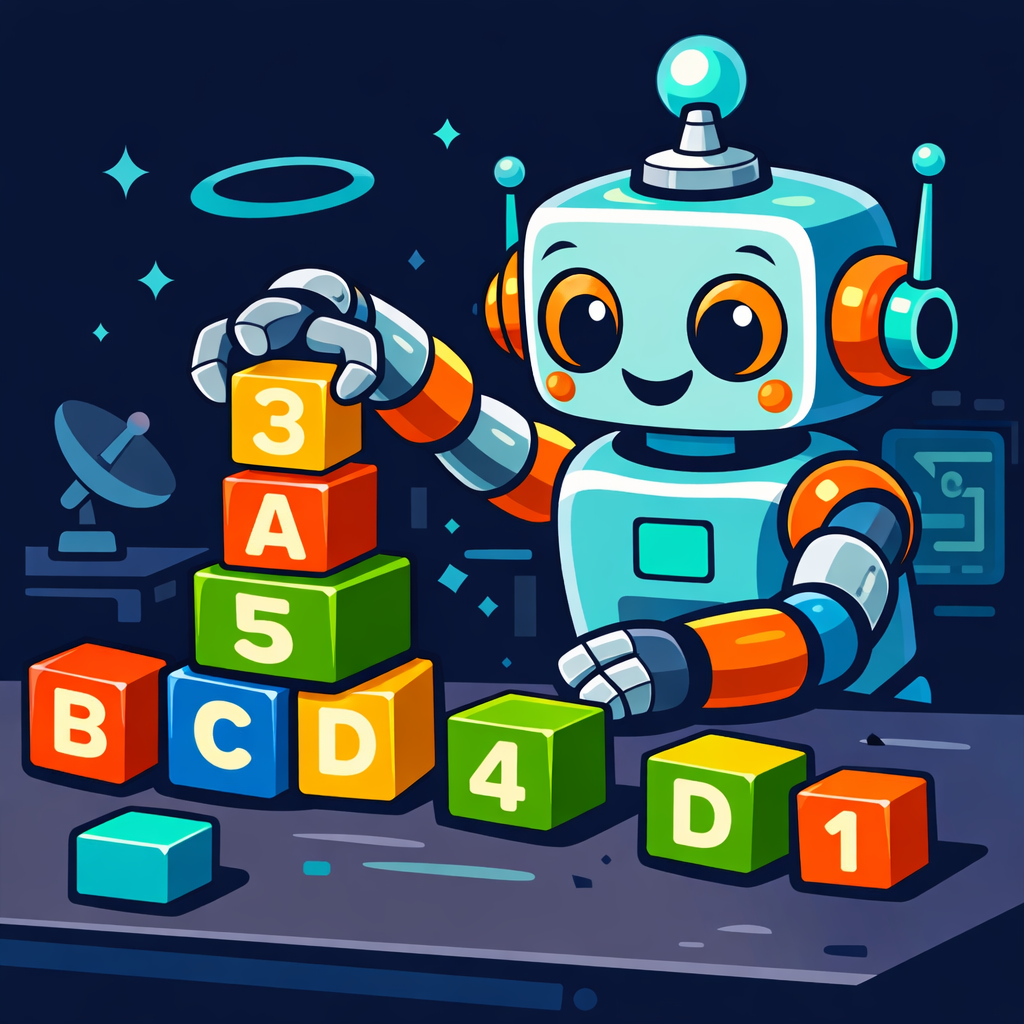
The ToyBlocks framework is a fascinating leap in robotics, not just for its controlled environment but for what it reveals about the future of robot learning. We're moving away from the cumbersome, error-prone real-world trials to something more systematic and scalable. This shift isn't just about convenience; it's a necessary evolution for AI-driven robotics to truly mature.
The real challenge in robotics isn't just getting machines to perform tasks; it's ensuring they learn and adapt efficiently. Controlled simulations like ToyBlocks allow us to tweak conditions, observe impacts, and refine behaviors without the chaos of the real world. It's about making robot learning repeatable and reliable.
Understanding the ToyBlocks Framework
ToyBlocks sets up a simplified playground where a robot arm manipulates blocks on a table. The genius here is in stripping down the environment to its essentials. This lets researchers zero in on the robot's learning process—pushing, flipping, and stacking blocks—without the noise of real-world unpredictability.
Per the announcement, ToyBlocks meets four critical needs: realistic physics, scalable task generation, a mix of reasoning and physical control, and broad task coverage. This controlled setup means models trained here should transition to physical robots with fewer surprises. But let's be clear: "fewer surprises" doesn't mean none. The real world will always have its say.
For those in the AI and robotics fields, it's crucial to understand the engineering elegance of ToyBlocks. By focusing on controlled variables, researchers can pinpoint exactly where a model's understanding or execution falls short. This is a stark contrast to real-world trials, where countless variables can obscure the root cause of a failure.
Technical Implications for Robotics
One standout feature of ToyBlocks is its ability to auto-generate training demonstrations. This isn't just a neat trick; it's a substantial reduction in time and effort for dataset preparation. By cutting out the need for teleoperation, researchers can focus on refining models and experimenting with task variations more efficiently.
Using reinforcement learning (RL) and motion planning, ToyBlocks quickly develops skills for short-horizon tasks. The integration with Nvidia's open-source Isaac Lab turbocharges this process, allowing for rapid skill policy generation—much faster than traditional methods. This is a game-changer for those who know the grind of hand-tuning models in real-world settings.
Domain randomization is another critical aspect. By altering physical properties like block size or table height, researchers test a model's ability to generalize. This is crucial because real-world conditions are rarely static. If a robot can't adapt, it's not ready for deployment.
Engineers familiar with AI systems development will see parallels here to the challenges of multi-agent workflows and retrieval-augmented generation (RAG) in software. Both require robust handling of variability and exceptions. In robotics, domain randomization serves a similar purpose as tuning retrieval quality in RAG pipelines—ensuring resilience across diverse scenarios.
Considerations for Builders
If you're designing robotic learning systems, ToyBlocks offers a blueprint for creating effective controlled environments. Start small and focus on controlling variables meticulously. Scale tasks incrementally to refine your models efficiently.
Automate task generation and evaluation to minimize manual intervention. The quality of your simulated physics and realism is non-negotiable—it directly affects how well your models transfer to the real world. Neglect this, and you're setting up for failure.
Diverse training data is your safety net. Include a wide range of tasks and scenarios to ensure your robots aren't just good in their training environments but can handle surprises in the field.
From my experience building AI systems, one key takeaway for developers is the importance of feedback loops. Just as in a contact center AI workflow, where continuous monitoring and adjustments are vital, robotic systems need constant evaluation and fine-tuning. Automation in task demonstrations and evaluations can help create robust models more efficiently.
Concrete Comparisons
Consider the evolution of contact center automation workflows. Initially, these systems were rigid and often failed in real-world applications due to the complexity of human interactions. Over time, with better simulations and controlled testing environments, they became more adaptable and reliable. ToyBlocks serves a similar role in robotics, providing a controlled environment to test and refine before deploying in the unpredictable real world.
Another comparison is with AI receptionist platforms, where voice and SMS handling are simulated to perfection before rollout. The meticulous preparation in these environments echoes the purpose of ToyBlocks—ensuring that models can transition smoothly from the lab to live environments.
Final Thoughts
Frameworks like ToyBlocks are more than just a step forward; they're a necessary pivot. They offer a controlled way to build smarter, more adaptable robots capable of tackling complex tasks with precision. By focusing on controlled environments early in the learning process, we're laying the foundation for more robust and reliable robotics. This isn't just about making things easier—it's about making them possible.
The engineering mindset required here is one of precision and foresight. As we build these frameworks, we must anticipate future challenges and design our systems to be as adaptable as possible. The controlled environments of today are the proving grounds for the autonomous robots of tomorrow.