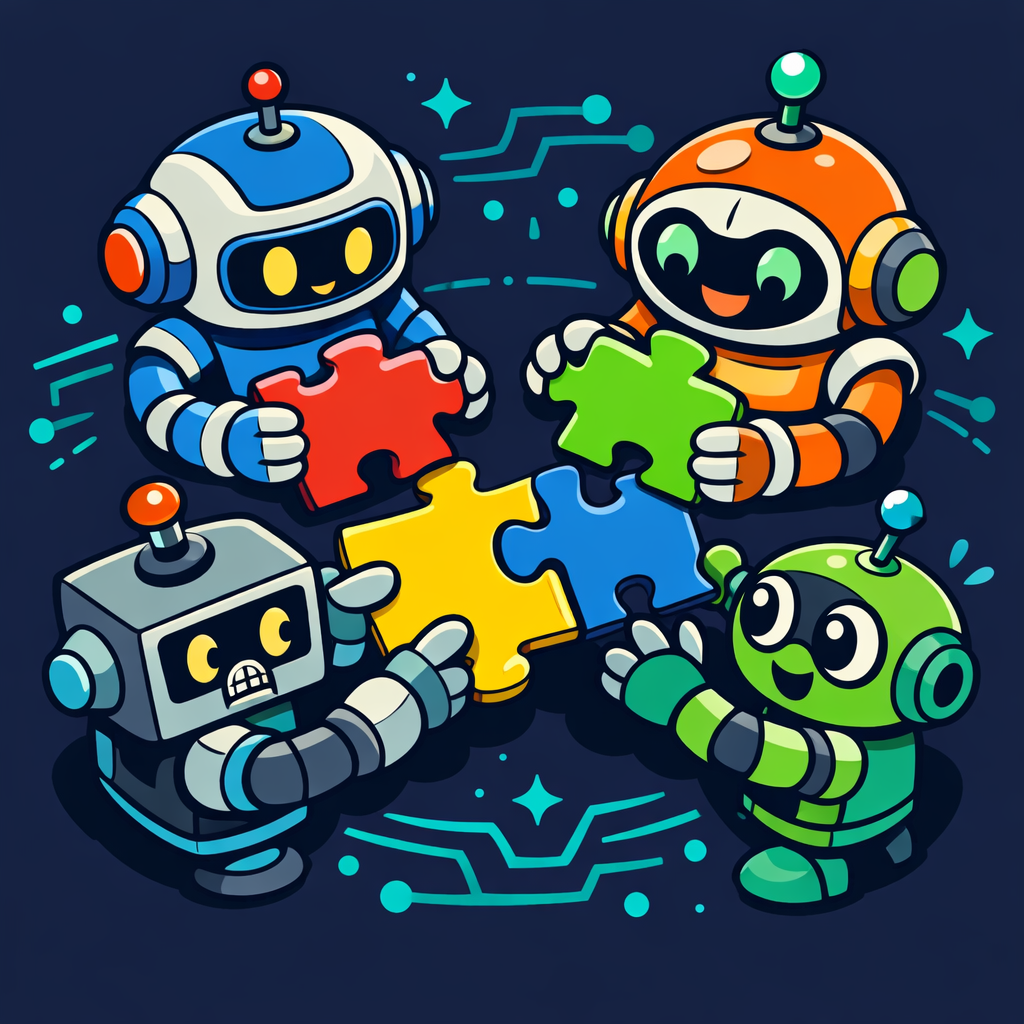
Multi-agent systems are often portrayed as the future of AI problem-solving, promising efficiency through collaboration. But let's cut through the noise: do they genuinely outperform single-agent systems, or do they just drive up computational costs without delivering real value? This is the critical question for those of us building these systems from the ground up.
The concept of AI 'swarms', multiple agents working in concert, is gaining popularity. The theory is that sharing information among agents can lead to more effective problem-solving. But in reality, the benefits of such coordination aren't as straightforward as they might appear. The real challenge lies in determining whether the communication between agents genuinely enhances task performance or merely adds complexity.
Evaluating Agent Communication
Integrating more agents fundamentally alters your system's dynamics, affecting everything from context management to computational budget. A key issue for engineers is understanding how agents communicate and whether this interaction truly offers a performance boost. The additional tokens required for communication have a cost, and it's crucial to assess if the performance gains justify this expense.
Recent explorations into multi-agent systems suggest that while a swarm of agents can achieve impressive results, the actual contribution from cooperation might be minimal. For developers, this means that simply adding more agents isn't a magic bullet. It's often about making more attempts rather than smarter ones.
Consider the trade-offs in latency and synchronization. With each added agent, the complexity of maintaining coherence across the system increases. This is particularly challenging when agents must operate in real-time environments, such as contact centers or live automation systems. The latency added by agent-to-agent communication can offset the supposed gains in efficiency.
Engineering Dynamics: Communication vs. Cost
Building effective multi-agent systems involves tackling several engineering challenges. The training process, particularly in a multi-agent setup, demands well-defined communication protocols and strategic updates to model weights. This complexity is magnified when dealing with decentralized partially observable Markov decision processes, where each agent has a limited view of the environment.
A fair evaluation requires testing under equal computational budgets. For instance, if you allocate a quarter of your total tokens to each of four agents, can they outperform a single agent with the full token allocation? This approach helps determine if the added complexity of communication is truly worth the computational resources.
From my experience designing AI systems, I've found that centralized data management during the training phase can mitigate some of these issues. By using a centralized training approach, you can leverage the collective data to fine-tune agent interactions. However, execution must often be decentralized to maintain the agility of individual agents. This duality presents a nuanced challenge for developers.

Scaling Challenges and Context Windows
Another technical hurdle is the management of context windows. Each agent operates within a limited context, and expanding this context to accommodate shared information can exponentially increase the system's resource requirements. This is especially true in RAG (retrieval-augmented generation) pipelines, where context management directly impacts retrieval quality and response accuracy.
In contact center scenarios, for instance, the cost per token for maintaining communication channels can be prohibitive. If agents are tasked with handling voice and SMS workflows concurrently, the synchronization overhead can quickly escalate. This is where careful architectural planning becomes indispensable, ensuring that the system's scalability doesn't lead to prohibitive operational costs.
Practical Takeaways for Developers
If you're working with multi-agent systems, start small. Begin with a handful of agents on straightforward, measurable tasks. This allows you to manage and analyze interactions before scaling up. It's essential to measure both the success of cooperation and the computational cost, as highlighted in a recent paper on the subject here.
Consider centralized training with decentralized execution. This strategy uses collective data during training but allows each agent to operate independently during execution. It strikes a balance between training efficiency and operational autonomy.
In practice, implementing a hierarchical structure where agents are grouped into tiers can streamline communication. For example, in complex systems like an AI receptionist platform, having a lead agent that coordinates sub-agents can reduce the complexity of direct communication channels between all agents.
Conclusion: Scrutinize Before Scaling
Don't let the allure of multi-agent systems overshadow practical execution and cost considerations. The potential for enhanced problem-solving is real, but only if communication leads to smarter, not just more, attempts. Engineers should critically assess the actual impact of coordination in their specific applications before committing to large-scale agent systems.
Ultimately, the decision to implement a multi-agent system should be driven by the specific requirements and constraints of your application. As with any technology, understanding the trade-offs and potential pitfalls is crucial to leveraging its full potential without incurring unnecessary costs.